


Registration in the Land Registry and Urban Planning Legality
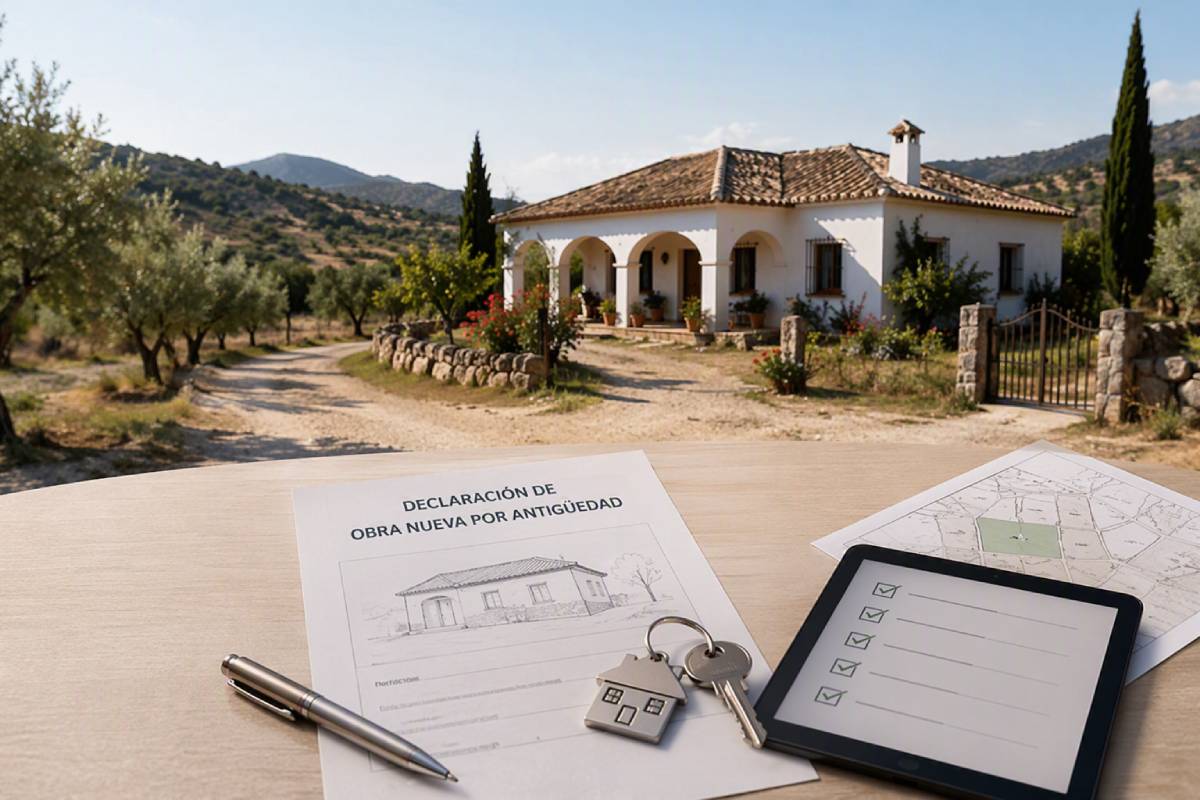
Many houses built years ago, especially on rural land, were never registered with the Land Registry (Registro de la Propiedad) for various reasons. The main reason is the absence of a building permit because the dwelling did not comply with the applicable urban planning regulations. In these cases, it is possible to register the property through the declaration of a completed building (or New Build Declaration) by virtue of age (obra nueva por antigüedad) procedure, regulated by Article 52 of Royal Decree 1093/1997.
This procedure allows registration in the Land Registry even if the dwelling is illegal from an urban planning perspective and was constructed without a building permit. In our daily legal practice, many foreign clients who are considering purchasing a property in Spain believe that registration in the Land Registry means that the property is legal, which is incorrect.
How to register a property based on its age in the Land Registry?
A property may be registered in the Land Registry provided that:
- The construction has been fully completed.
- A technical certificate is required to confirm the age of the building.
- The six-year period applicable in Andalusia during which the Administration may adopt urban planning enforcement measures involving demolition has elapsed.
- There is no urban planning enforcement proceeding recorded in the Land Registry.
To achieve this, a deed of Declaration of new-build property based on age must be signed before a Notary Public and then registered with the Land Registry once the Stamp Duty Tax (AJD) has been paid.
If the property is also not registered with the Cadastre registry, the relevant cadastral form must be filed together with the notarial documentation in order to request cadastral registration. In such cases, the Town Hall or tax collection authority may claim Property Tax (IBI) for the previous four years, together with late payment interest and surcharges.
What is the cost of a Declaration of new-build property based on age?

The costs will depend on the size and square metres of the construction to be registered, as the value of the construction must be declared in the new deed to be signed. Registering a swimming pool or storage building is not the same as registering an entire dwelling.
As a guideline, the costs are as follows:
- Technical certificate: €500 – €1,500
- Notary fees: €800 – €1,200
- Land Registry fees: €300 – €800
- AJD (Stamp Duty Tax): 1.2% in Andalusia on the declared value of the construction
Is registration of a property in the Land Registry mandatory?
No. In Spain, registration in the Land Registry is voluntary. However, from the perspective of legal certainty against third-party claims, it is the most important registry.
What is mandatory is that the property is correctly recorded in the Cadastre registry, which is the registry used by the Administration to determine the cadastral reference value of urban properties and undeveloped plots of land, and which is also used for the collection of taxes such as Property Tax (IBI).
Why is it advisable to register a property in the Land Registry?
Registration in the Spanish Land Registry is not compulsory, but it provides legal certainty and facilitates any future sale, inheritance, or transfer of the property.
Furthermore, in practice, virtually all banks require a property to be properly registered before granting a mortgage. The reason is simple: the lender needs the building to appear in the Land Registry in order to create mortgage security over the property.
Therefore, an unregistered property cannot be mortgaged and, where there are discrepancies between the physical reality of the property and its Land Registry description, difficulties may arise in obtaining mortgage finance or the amount available may be reduced.
Does registration of a property in the Land Registry mean that it is legal?
 Registration in the Land Registry does not mean that the property is legal. A property may be registered in the Land Registry while still being illegal from an urban planning standpoint. A property is considered illegal because it was built without a licence or because it does not comply with the urban planning regulations of the municipality in which it is located.
However, as explained above, where an illegal property can no longer be sanctioned or demolished because the statutory period for a sanction urban proceeding has expired (six years in Andalusia), registration in the Land Registry is permitted through this procedure.
It should be remembered that the registration of a legal property, built with the appropriate licenses and in compliance with planning regulations, follows a different procedure. Registration takes place once construction has been completed and the owner can provide the final building certificate, building licence, first occupancy licence (LPO), and other documents required for registration.
What is the Declaration of Assimilation to Out-of-Planning Status (DAFO or SAFO) in Andalusia?
When a property is built without a licence or in breach of planning regulations, and the property cannot be legalised because it is contrary to the planning rules applicable in the municipality where it is located, the Town Hall may recognise its situation through a procedure known as DAFO or SAFO.
However, a DAFO does not legalise the property. It merely certifies that:
- The construction was carried out irregularly.
- The period for adopting measures to restore planning legality has expired.
- Any planning infringement is time-barred from an urban planning enforcement perspective and therefore the property can no longer be demolished or sanctioned.
- The building meets the minimum habitability requirements and has water and electricity supplies, as well as adequate wastewater treatment.
Maintenance and conservation works may be carried out, and in some cases certain refurbishment or renovation works may also be permitted. However, the built area cannot be extended and changes of use are generally prohibited, such as converting a garage into a dwelling.
Therefore, a property with DAFO or SAFO status remains an irregular or illegal construction, although its administrative situation has been formally recognised by the Town Hall.
This procedure is most common for properties located on non-developable or rural land, although it may also apply to urban properties.
In mortgage transactions involving rural properties, the existence of a DAFO/SAFO resolution issued by the Town Hall is particularly important, as many lenders will not grant mortgages on such properties unless they have obtained this recognition.
Is it possible to build on rural land in Andalusia?
The Andalusian planning legislation (LISTA and its Regulations), like the previous regulations it replaced, restricts new development on rural land.
As a general rule, new buildings on non-developable land are only authorised when they are linked to:
- Agricultural or livestock activities.
- Forestry activities.
- Public interest projects, tourism developments, or tourism complexes that are beneficial to the municipality from an economic perspective.
- Constructing isolated residential dwellings in Andalucian countryside, provided that a series of very strict requirements are met. In practice, these requirements make authorisation of such developments extremely difficult.
In most Spanish autonomous communities, the possibility of building on non-developable or rural land is very limited and is generally not permitted.
C&D Solicitors Andalusia

