Inheritance Tax in Andalusia

INHERITANCE TAX IN SPAIN: WE ARE ALREADY EUROPEAN!

Inheritance Tax in Andalusia

In our post of last March on Inheritance and Donation Tax, we discussed about the fact that European non-resident citizens in Spain were experiencing discrimination against resident citizens, because, under the same circumstances, they had to pay more taxes than resident taxpayers.

This unequal treatment happened when the deceased or beneficiaries were non-resident in Spain and they paid taxes in conformance with a State regulation which was more detrimental than the regional one, which was only applied to resident citizens.

This discrimination was confirmed by the European Court of Justice ruling dated 03rd of September 2014, which resolved this issue and established that Spain was infringing the free movement of capital within the EU, because of this separate treatment between resident and non-resident citizens.

On the 1st of January 2015, in order to comply with the aforementioned judgment, the amendment of the State Inheritance Tax regulation has entered into force in Spain. A special scheme has been introduced in regards of the Inheritance Tax, so that non-resident citizens in Spain who are European residents may apply the regional regulation as residents already do, equating their situation.

This new regulation establishes that in the event that the deceased is a European non-resident in Spain, the European non-resident beneficiaries may apply the regional regulation where the most valuable assets are located in Spain. If the beneficiaries are resident in Spain, the regional regulations where they reside shall be applicable.

If the deceased has been a resident in a Spanish region and the beneficiaries are non-resident in Spain, the non-resident beneficiaries shall pay inheritance tax in conformance with the regional regulations where the deceased resided.

At this point, it is worth mentioning that the collection of the Inheritance and Donation Tax in Spain is assigned to regional governments, so that they are free to set forth their own regulations.

The effect of this assignment is that the amount to be paid for this tax by Spanish residents may significantly vary depending on the region where they live. In fact, a fiscal “war” has arisen between regional governments as regards of this tax, because some people have decided to establish their residence in regions with a more favourable tax scheme in order to pay fewer taxes for inheritance and donations, particularly those with more valuable estates.

The most recent and famous case in Andalusia was that of the late Duchess of Alba, who was sentimentally related to Andalusia but not fiscally, because her residence for tax purposes was in Madrid. The main benefit of this fact is that her beneficiaries have had a tax saving of more than 90 million Euros in the Inheritance Tax.

Since non-resident citizens will also enjoy the same Inheritance Tax regulation than resident citizens and considering that the regulation to be applied is that of the region where the most valuable assets are located, this unequal treatment between regions will also affect them.

However, imagine that you are a non-resident in Spain, do not have any property, but you have some money in a bank entity in Spain. In this case, which regulation shall be applicable for your beneficiaries? It seems that the applicable regulation shall be that of the region where the bank registered office is located. Thus, it is not the same a bank entity with registered office in Madrid, Barcelona or Seville, for instance. It has been said “it seems” above, because a definitive answer has not been obtained when contacting the Tax Administration Office in respect of this issue.

In short, these are good news for European foreign citizens and their beneficiaries, and welcome to the regional regulatory “chaos” in respect of Inheritance and Donation Tax.


Author: Gustavo Calero Monereo, C&D Solicitors (lawyer)

Torrox-Costa (Malaga/Costa del Sol/Andalucia)

FUTURE REFORM IN ANDALUSIA FOR THE OWNERS OF HOMES CONSTRUCTED ON NON-DEVELOPABLE LAND

FUTURE REFORM IN ANDALUSIA FOR THE OWNERS OF HOMES CONSTRUCTED ON NON-DEVELOPABLE LAND

Andalucian houses constructed non-develople land
Andalucian houses constructed on non-develople land

Three weeks ago the Junta de Andalucia (Andalusian Regional Government) announced a reform of the Urban Development Law for Andalusia (LOUA) which aims to provide further legal security for owners of homes that are built on non-developable land (rustic land).

With the current LOUA regulations, for those buildings constructed on rustic land in Andalusia and which are within a zoning plot, the prescription period of six years that the administration has to “attack” these constructions on rustic land does not apply. In other words, no time limit is established, therefore the government leaves open the possibility to begin administrative procedures against said plot and the constructions that are on it, when it deems convenient, even if it has been over six years since the home was built.

The above has the main effect that a building on rustic land, built over six years ago on a property that has not been segregated, cannot be penalised or “attacked” by the government, whereas if the construction is part of a segregation/plot division it could be penalised in spite of being built over six years ago, and demolition of the homes built on this plot could be ruled, as established in article 49 of the Regulations on Urban Development Discipline. Regarding this article, I point out that in spite of it and in my opinion, I do not think that it is feasible to carry out any demolition under this precept due to several legal reasons.

The problem with current regulations since the LOUA came into effect in 2003 is that no serious monitoring or inspection policy has been implemented by the Junta de Andalucia and the Town Halls on rustic land. This has led to the proliferation of thousands of new homes and plot divisions throughout Andalusia, especially during the times of the real estate boom, and more so on the Costa del Sol, where this speculation reached unsustainable proportions.

In spite of the fact that it was feasible to control these constructions, it was not done and this led to the buildings entering the legal level, with many owners purchasing in good faith with all the appearances of legality. This has shown that current regulations in Andalusia on rustic land, and specifically on plot zoning, are pointless, because no one has made sure that they were enforced, making them inefficient at best.

Now the intention is to modify the LOUA and provide the possibility for isolated constructions located on plots of rustic land to regularise their situation through the figure of assimilating it as unregulated, that was introduced by the Decree of 2012. This will be so provided that the period of 6 years has elapsed without the government beginning any penalisation procedures against these buildings, therefore to these purposes the legal situation is considered as equal to those homes that are not located on a zoning plot.

It will take a period of 5 or 6 months for this reform to be approved, and it will be approved by parliamentary proceedings, therefore changes will be included during its approval.

I understand that this initiative by the Junta de Andalucia is a first step towards solving this problem. We all would have preferred for this not to have happened and that rustic land would never have been part of town planning speculation, but this problem started many years ago and the issue is clear; what to do with thousands of homes that cannot be demolished now?

Most of these homes are inhabited and they are still being bought and sold between private persons, therefore it is necessary to regularise them so that third parties acting in good faith have legal security as owners of these properties. Likewise, it is reasonable that those that were built without a building permit, which is most of them, should assume a cost for the regularization procedures and they should contribute the same as any citizen who wishes to build a house, and this bearing in mind that the acknowledgement by AFO is not the cure-all either. From an ecological and environmental standpoint, the legalisation procedure must guarantee that these homes do not cause any further damage to the area where they are located, and that their waste water is completely purified by autonomous installations, because as long as they are fully illegal, and cannot be “attacked” by the government, each owner will do what they see fit and damage to the environment will be higher.

In short, given the current situation and bearing in mind the problem that has been created due to the inactivity and lack of control by the public administrations, from a legal, financial and environmental standpoint, we must establish a regularization procedure for these homes. If not, if we continue with the current situation, it would be a great mistake and it would only continue to aggravate the problem as the years go by.


Author: Gustavo Calero Monereo, C&D Solicitors (lawyer)

Torrox-Costa (Malaga/Costa del Sol/Andalucia)

THINKING ABOUT SELLING YOUR PROPERTY IN SPAIN? DO IT IN 2014 TO AVOID PAYING MORE TAXES

THINKING ABOUT SELLING YOUR PROPERTY IN SPAIN? DO IT IN 2014 TO AVOID PAYING MORE TAXES

Capital Gain Tax when selling Spanish property

Next 1st of January 2015, a new tax reform will come into effect. This reform was approved in August by the Spanish Government and, among other measures, it will affect taxation of capital gains obtained as a result of a property sale in Spain:

1) Tax reduction from 21 % to 20 % for capital gains earned by a sale if the seller is non-tax resident in Spain.

2) Tax reduction from 21 %-27 % to 20 %-24 % for capital gains earned by a sale if the seller is a tax resident in Spain.

In these terms, it may seem that, from the 1st of January 2015, taxes for capital gains earned by a property sale will be reduced. However, you should be careful with this reform, since from the 1st of January 2015 sellers of a property may not be enable to apply reducing and updating coefficients of the purchase value when the property was bought.

You may wonder what it means; and it means that heretofore if you bought a property and then you sold it, when calculating the capital gain from the sale, you could update the price paid when you bought the property a few years ago, however, from 2015, this purchase value will not be allowed to be updated. For example:

You bought a property by public deed for 150,000 Euros in 2003 and now it is on sale for 200,000 Euros.

1 ) IF YOU ARE NON-TAX RESIDENT IN SPAIN

–          if you sell your property in 2014: the updated purchase value would be 177,540.00 Euros and 4,716.60 Euros should be paid for taxes as a result of a capital gain of 22,460.00 Euros taxed at 21 % rate.

–          If you sell your property in 2015: the purchase value would be 150,000 Euros (no update is allowed) and 10,000 Euros should be paid for taxes as a result of the capital gain of 50,000 Euros taxed at 20 % rate.

2) IF YOU ARE TAX RESIDENT IN SPAIN

–          If you sell your property in 2014: the updated purchase value would be 177,540.00 Euros and 5,375.00 Euros should be paid for taxes as a result of the capital gain of 22,460.00 Euros obtained.

–          If you sell your property in 2015: the purchase value would be 150.000 Euros (no update is allowed) and 10,880.95 Euros should be paid for taxes as a result of the capital gain of 50,000 Euros.

As shown by these examples, tax savings when selling your property in 2014 or from the 1st of January 2015 may be worthy of consideration.

Other examples of updated values with the same prices above: if you bought the property in 1995, the updated value in 2014 would be 210,750.00 Euros; then, you should not pay taxes for capital gain if it is sold in 2014 and you should pay 10,000 Euros for taxes if it is sold in 2015.

If you bought the property in 2013, the updated value in 2014 would be 154,454.00 Euros, then if you sell it in 2015, you would pay less taxes than selling it in 2014; however, this a small saving between 400-700 Euros according to whether the seller is a non-tax resident or tax resident in Spain.

In these examples, neither deductible expenditures (taxes, notary, registry and estate agent fees, etc.) have been taken into account, nor other possible deductions to which fiscal residents may be entitled.

CONCLUSION: if you are thinking about selling your property in Spain, you will probably be interested in doing it before the end of 2014, you will avoid paying more taxes for the profit obtained on the sale.

If you have recently bought a property or the sale price is very similar to the purchase price, you may be interested in selling it from 2015, as there is not a great difference regarding taxation. If you are selling at a loss, that is, you obtain no profit, it makes no difference whether selling it this year or the following.

Nevertheless, the most coherent decision is to make your own tax estimation for your particular case in order to know whether it is more convenient to sell this year 2014 or not, so you will have a clear idea of your possible tax savings.


Author: Gustavo Calero Monereo, C&D Solicitors (lawyer)

Torrox-Costa (Malaga/Costa del Sol/Andalucia)


CADASTRAL REGISTER: TO BE REGISTERED, THE QUESTION IS CLEAR

CADASTRAL REGISTER: TO BE REGISTERED, THE QUESTION IS CLEAR

Cadastre registration Spanish properties

The cadastre is a compulsory administrative register which depends on the Ministry of Finance. It keeps the description of rural and urban properties as well as properties with special features. This register has nothing to do with the Land Register, where registrations are voluntary and legally prevails over the Cadastre.

Cadastral registration by property owners is compulsory, as provided by Article 11 of Spanish cadastral law Ley del Catastro Inmobiliario; that is, title holders to the properties shall declare before the Cadastre Office any variation or modification as for example: conveyance, new constructions, land partitions and additions and any other necessary information so that cadastral descriptions of properties are in accordance with the facts.

Consequently, owners’ obligation to adapting the physical reality of the property to the cadastral facts is clear.

Articles 70 and 71 of the Spanish law Ley del Catastro set out the rules on infringements and penalties, so that “failing to submit declarations, submit them after deadlines or submitting false, incomplete or incorrect declarations” may be considered an infringement punishable by a fine from 60 to 6,000 Euros. To date, we have no evidence that the Cadastral Register is penalizing owners for failing to submit the necessary declarations, although these are not submitted.

The problem that we have noted is that the Cadastral Government Office in Malaga refuses to accept modifications on properties built on non-developable lands and requested by owners or their legal representatives, despite it is deemed that the documents legally required has been submitted for these proceedings. We reiterate that the Cadastre is a compulsory register and as a result it is important to be taken into account.

As far as we understand, the Cadastre systematically refuses some variations and modification on non-developable lands; consequently, it is requested additional documentation which we consider to be unnecessary and should not be demanded according to Spanish law. In view of this situation, which we understand that is not applicable to law, our law firm has filed complaint actions against different administrative proceedings, which are pending to be resolved by the Economic Administrative Court of Malaga.

If owners are obliged to declare their property modifications or variations before the Cadastral Register Office and their legal documents are provided, what is their responsibility if the Cadastre denies their request or asks for further documentation that owners do not have?

From our point of view, the fact of requesting the cadastral variation or modification providing the necessary documentation should exempt owners from any infringement imposed by the Cadastral Register, since they did their best to adapt the physical reality of their property to the cadastral facts.

On the other hand, the Minister of Finance approved last year the cadastral regularization procedure 2013-2016, by which the Real Estate Cadastre intents to incorporate ex-officio urban and rural properties with constructions, as well as any variations of their features, so that these properties are recorded in the Cadastral Register and the Spanish property tax IBI may be collected.

In Malaga, just a few municipalities has acceded to this procedure, by which owners are requested the payment of a 60 Euros fee to carry out this regularization, although it is probable that other municipalities also accede to this procedure in the following years.

To sum up, and despite the existing difficulties to register in the Cadastre some modifications or variations, we advise owners to check if their property is correctly registered in the Cadastre, so that they may request before this register office the necessary modifications and variations to adapt the physical reality of their property to the cadastral facts. As a result of this action, they will avert potential problems.


Author: Gustavo Calero Monereo, C&D Solicitors (Torrox-Málaga)

PLUSVALIA TAX PAYMENT WHEN THE ACTUAL VALUE OF CONVEYED PROPERTIES HAS DECREASED

PLUSVALIA TAX PAYMENT WHEN THE ACTUAL VALUE OF CONVEYED PROPERTIES HAS DECREASED

Spanish Plusvalia tax decreased value property
Spanish Plusvalia tax with decreased value property

Currently, as a result of the existing conditions of real estate market, the sale price of a real estate property may be below the purchase price or slightly above it.

As regards of these situations and in connection to taxes to be paid when selling a property in Spain, it is necessary to clarify that the increase in urban land values is the first element of the taxable event of the local tax on the increase in urban land values (Spanish acronym I.I.V.T.N.U.), commonly called PLUSVALÍA. Thus, in the event of no increase, no tax may be applied, despite the content of the objective rules for the calculation of the tax provided by Article 107 of Spanish law regulating local taxation (L.H.L.), since no tax liability may arise when an essential element of the taxable event is missing.

The legal liquidation system does not preclude that the taxpayer proves in the specific case that the application of the calculation methods by the Tax Administration leads to unrealistic results. On the other hand, regarding the formula of Article 107 L.H.L., the Supreme Court ruling dated 22nd of October 1994 was conclusive when maintaining that this article was subsidiary, defending and safeguarding taxpayers. According to this Judgment “legal regulations only provide a rebuttable presumption, which is subject to be distorted in each particular case by appropriate and sufficient evidence in the above terms for the taxpayers and in conformance with the provisions of Article 385 of the Spanish Civil Procedural Law. This reasoning, in regards of the actual increase in value(plusvalía) from property sales leading to non-taxation, was also highlighted by the Supreme Court in the Judgment dated 29th of April 1996 and the Judgment dated 22nd of September 2001.

However, a recent Judgment from the High Court of Justice of Catalonia dated 18th of July 2013 also pronounces undoubtedly the fact that town councils cannot charge the plusvalía tax in the event that it does not exist, since the Judge states that when an essential element of the taxable event is missing –as for example obtaining a profit from a property sale—no tax liability to pay plusvalía tax may arise.

Recently, it is being confirmed an increase of court rulings admitting taxpayers’ appeals against tax liability in the event of loss of assets. In the words of Pablo Chico de la Camara, Professor of Financial and Taxation Law: “the caselaw of the Constitutional Court confirms the impossibility to tax a nonexistent taxable wealth by the local authorities”. This situation may occur when the transferor may certify the loss of assets on the occasion of a land conveyance. It is clear for the Supreme Court that the nonexistence of increase in land values precludes the application of the Plusvalía tax.

To sum up, the objective absence of increase of land value may lead to non-taxation, as a result of the nonexistence of the taxable event, since the legal contradiction cannot and should not be resolved in favour of the “calculation method” and to the detriment of the economic reality. Consequently, it would mean the ignorance of the principles of equity, justice and economic capacity.

These same conclusions shall be applied when an increase of the value occurs and the amount of this increase is proved to be lower than the result of applying this calculation method, being the same principles infringed.

These conclusions, which are already supported by several doctrinal criteria and caselaw, shall be considered as unquestionable at present, in view of the aforementioned economic reality.

In SHORT: when it is certified and proved in a specific case that there has not been an economic and actual capital gain from a property sale, the payment of the Plusvalia tax (I.I.V.T.N.U.) shall NOT be required by town councils.

But the reality is that Town Councils are still requiring the payment of this tax despite properties are sold at a loss, so that the judicial procedure is the only chance in this case for taxpayers to “tackle” the payment of this tax. However, when the resulting plusvalía tax payment is relatively low, it is not worth taking legal actions, due to legal costs.

For those who decide to claim, we understand that there are sufficient legal and solid arguments to obtain a favourable judgment.


Author: Francisco Delgado Montilla, C&D Solicitors (lawyers)
Torrox-Costa (Malaga/Costa del Sol/Andalucia)

Golden Visa Spain

SPANISH GOLDEN VISA FOR NON-EUROPEAN RESIDENTS

Golden Visa Spain
Golden Visa Spain

During our stay at the Second Home fair in Utrecht this March we received several questions about the new Spanish ´Golden Visa´ (or ´Investor Visa´) from professionals with wealthy clients in China and Africa. With the rapidly growing middle and upper-class in these new economies, these questions are rather interesting for us as a law firm specialized in property law / conveyance.

With this new investor visa law the Spanish government tries to attract foreign investors in order to stimulate the national economy, to give an impulse to the real estate market and to create more jobs. Politicians up to now are rather enthusiastic, as up to the 14th of April already 661 Golden Visa were granted to investors from China, Singapore, Japan, the United States, South America, the Middle East and Russia. With this article we´d like to inform you about the details of this Spanish law that became active on the 27th of September 2013.

Non-European residents can apply for the Golden Visa under several conditions. The ‘cheapest way’ for them is to buy a Spanish property with a purchase price of over € 500.000. But there are more options for the lucky few that can financially afford to immigrate to Spain. Investing in Spanish companies with shares of € 1.000.000, or having a Spanish bank deposit in Spanish financial entities of the same amount of money, will also do.

There is another option for obtaining a Golden Visa, which is buying Spanish bonds / public debt titles with a worth of € 2.000.000 or more (minimal duration 5 years). In addition, it´s also possible to obtain the Golden Visa by starting a business activity in Spain with a significant worth to the national economy, such as job creation, socioeconomic improvement or scientific/technology innovation. Of course, this officially needs to be approved by the Spanish administration (Economical and Commercial Office). The last option concerns high qualified professionals or transactions within the same company (issued by the Big Companies and Strategic Group Unit).  The condition, of course, is that these professionals can´t be found on the Spanish employee market.

The rights of the residence permit apply to the permit holder and his spouse, children up to 18 years and also -due to health reasons- dependent parents or children over 18 years.

The Golden Via is granted for one year (a normal tourist’s visa only lasts for 90 days) and is renewable for two years, after which another two more years can follow (as long as the investment maintains). After these 5 years you would be entitled to apply for a long-term residency, but this permit will not be granted automatically. The requirement here for is that the applier has lived in Spain legally and effectively for five years, which means that within these 5 years he hasn´t lived abroad for more than 6 months consecutively and for not more than 10 months in total.

Of course, along with the permission comes a set of demands, of which the following are the most important. The person may not have stayed illegally in Spain before, can´t have a criminal record in Spain (o due to the Spanish legal system in the last 5 years) and he needs to have sufficient economic recourses for his (and his family´s) stay in Spain. It´s not obligated to have a tax residency within Spain, though, which makes the Golden Visa even more attractive for foreign investors.


Author: Francisco Delgado Montilla, C&D Solicitors (lawyers)
Torrox-Costa (Malaga/Costa del Sol/Andalucia)


SUCCESSFUL DUTCH REAL ESTATE FAIR FOR C&D

SUCCESSFUL DUTCH REAL ESTATE FAIR FOR C&D

Seminar ´Buying a house in Spain

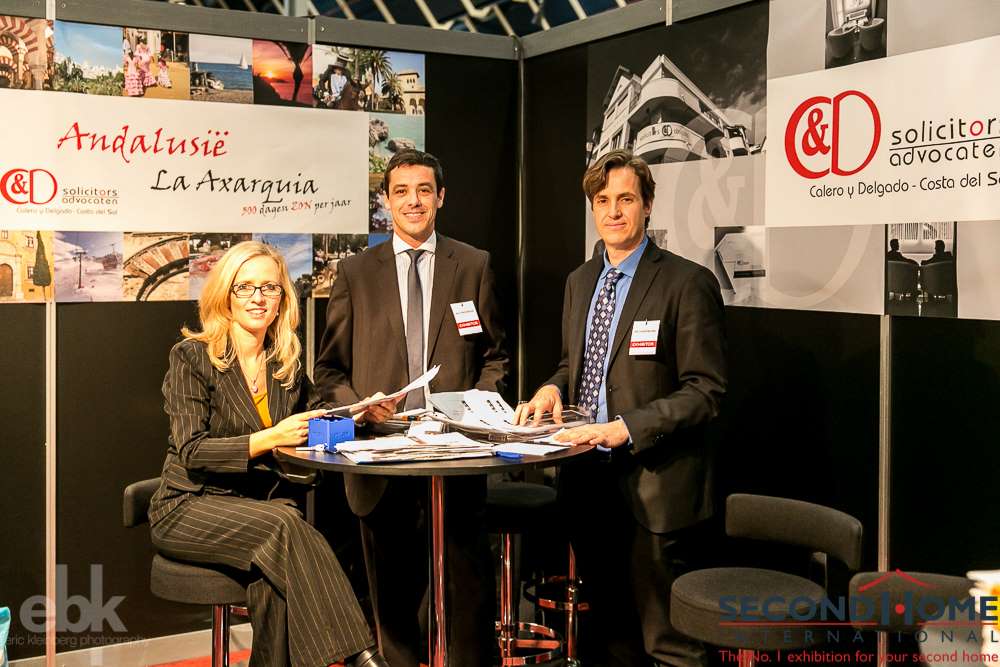
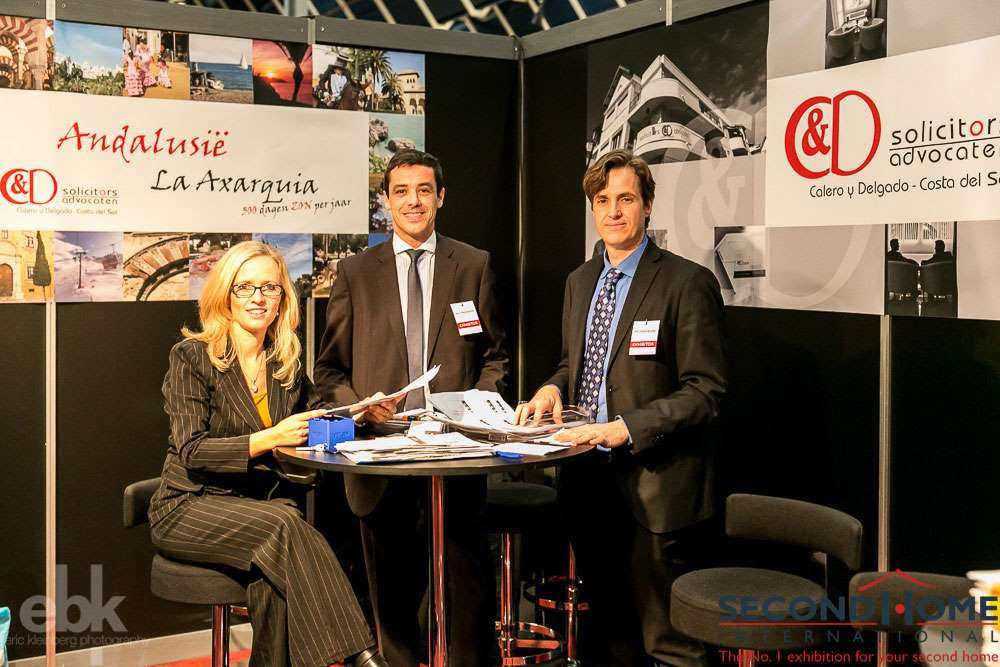
As we already informed you in our previous news letter, C&D has been present at the Dutch Second Home fair in Utrecht last month. Being the only Spanish law firm on the fair, our daily seminars about the Spanish purchase process turned out to be the best attended during these three days, which proves that Spain is still a very attractive country for the Dutch to invest in. Also more than half of all exhibitors (mainly real estate agencies and developers) were focussed on Spain, which according to the organisation already has been the case for many years now.

In our stand we were able to speak to a lot of people with serious plans on buying a property in Spain, in most cases on the Costa del Sol or even particularly the Axarquia. The main issue in our conversations was to explain the important role of the lawyer during the purchase of a property in Spain. This situation is different from the Netherlands as in this country the lawyer´s work is completely done by the notary. We also got a lot of questions regarding wills and tax issues, for example on the subject of renting out a new bought property.

Author: Gustavo Calero Monereo, C&D Solicitors (Lawyers) Torrox-Málaga

Stand of C&D Solicitors on Dutch Second Home Fair in Utrecht

Our daily seminar we held in both Dutch and English and we explained the different phases of the buying process with the various legal documents there are to sign (reservation contract, private purchase contract and the title deeds). Besides of this we gave some background information on the official investigation of the lawyer, by which the future owner can make sure he´ll buy his property with all possible guarantees and free of any risks. (The extended Dutch text of our seminar you can find on the home).

Looking back we can say that this fair exceeded our expectations and has been really successful for us. Not only in the perspective of attracting new clients but also as a learning experience of presenting our company on the Dutch market. Despite of the good weather this Second Home edition in Utrecht attracted around 5.000 visitors.

Author: Francisco Delgado Montilla, C&D Solicitors (lawyers)
Torrox-Costa (Málaga/Costa del Sol/Andalucia)

C&D AT SECOND HOME FAIR IN UTRECHT

C&D AT SECOND HOME FAIR IN UTRECHT

erfrecht spanje
Dutch Second Home Fair

C&D Solicitors likes to inform you about the fact that we will be present at the Second Home Fair in Utrecht (the Netherlands) from the 28th until the 30th of March.

As the only Spanish law firm on this fair we´ll provide Dutch visitors with legal and fiscal information concerning the Spanish purchase process. We also have been invited to -together with our Dutch commercial assistant- give a daily seminar, which will start at 14:45 hrs. (seminar 1). After this seminar exists the possibility to ask us specific questions in the fair´s wine bar that will have a special theme on Spanish wines.

If you happen to be able to visit the fair, you can download free tickets through this link and we look forward to welcome you in our stand!

Author: Francisco Delgado Montilla, C&D Solicitors (lawyers)
Torrox-Costa (Malaga/Costa del Sol/Andalucia)

SPANISH INHERITANCE TAX: POSSIBLE CONDEMNATION AND CHANGES

SPANISH INHERITANCE TAX: POSSIBLE CONDEMNATION AND CHANGES

Did you pay too much Spanish inheritance tax?
Have you paid too much Spanish inheritance tax?

Last 27th of March 2012, the European Commission pursued an action against Spain for the breach of the Treaty on the Functioning of the European Union and the Agreement on the European Economic Area, as a result of the discrimination in respect of the Spanish inheritance and gift tax, since non-residents pay more taxes than residents under the same personal conditions.

Spanish inheritance tax is managed by Spanish autonomous regions, so there are significant differences from one region to another in respect of this taxation. Each regional administration has regulated this tax in a different way. However, if the taxpayer is a non-resident, the Central State Tax Administration Office is the competent body to collect this tax payment instead of the regional government tax office. Regional government regulations are much more favourable for taxpayers than central government tax rules, since regional administrations have established tax exemptions and reductions for the inheritance and gift tax.

However, these discriminatory situations between residents and non-residents in Spain also arise between residents of the different autonomous region. In fact, last 8th of May 2013, a court order from the Spanish Supreme Court established the illegality of the inheritance regulations of the Valencian autonomous region, because these regulations allow heirs residing in this region to benefit from tax reductions against those residing in other Spanish regions who do not enjoy from this benefit.

It is expected that in the future the Spanish Constitutional Court itself rules in this respect. Furthermore, upon consideration of this inequality legal situation, it is likely that the inheritance tax may be reformed in the medium and long term in order to balance differences among the different Spanish autonomous regions.

Regarding the action against Spain, last 8th of January the hearing for this proceedings was held before the Court of Justice of the European Union. It is very likely that a judgment may be pronounced in a few months in regards of this case. If this court order condemns Spain because of this discrimination, it may give rise to a right for reimbursement of undue taxes paid to all those non-residents in Spain who paid in the last 4 years the Spanish inheritance and gift tax, provided that this payment had been higher than the tax payment corresponding to residents belonging to this Spanish region under the same circumstances.

Taxpayers may claim within 4 years. This period starts to run from the date of tax payment. For this reason, in the event of a possible ruling condemning Spain in this regard in the following months, it is very important that all those non-residents in Spain, who paid inheritance and gift tax in the last 4 years,  check if their payment was higher than the one made by a resident in the same Spanish region. If that were the case, they should claim for the refunding before the end of this 4 years period. Once this period expires, they will not be entitled to it. The submission of this tax refund claim shall stop the 4 years expiry date while it is decided if Spain is condemned for this issue.

Our law firm is at your disposal to assist you in this matter. We would offer you our service on the basis of a “no win-no fee agreement” for the submission of the aforementioned tax refund claim before the Tax Authorities, that is, you would pay nothing to us if the public administration declines this first claim.


Author: Gustavo Calero Monereo, C&D Solicitors (Lawyers)
Torrox-Costa (Malaga/Costa del Sol/Andalucia)

SPANISH PUBLIC TAX ADMINISTRATION REVIEWS PROPERTY TRANSFER VALUES

SPANISH PUBLIC TAX ADMINISTRATION REVIEWS PROPERTY TRANSFER VALUES

Spanish Tax Administration reviews property value

In the last few years, property market prices have dropped in Spain and the cases in which the National or Regional Tax Administration has reviewed declared values for property transfers have increased, whether for conveyance, inheritance or gifts; that is, you may sell your property for a certain and determined price, but the Regional or National Tax Administration may review that value after the sale and for tax purposes; then, it may consider that the real value of this sold property is higher than the one declared on the deed of sale, and therefore, the buyer shall pay the Transfer tax (ITP) on property transfer on the basis of the new value, which has been reviewed by the Regional Tax Administration, although the buyer had bought it for a lower price. In addition, the seller may have to declare capital gains higher than those actually obtained as a result of the review carried out by the National Tax Administration.

The abovementioned situation is legal and possible pursuant to Article 57 of Spanish general taxation law, in which it is provided that the Public Administration may check the property values by using different means.

Regarding urban properties, the Regional Tax Administraions and the Andalusian Regional Government are often supported on the grounds of an Order that is yearly approved to calculate the taxable minimum value of urban properties in this regard. As a result of this, it is possible to calculate this taxable minimum value from applying a rate provided by this Order to the details contained in the real estate tax IBI receipt (council tax). Then, you can know in advance whether the Tax Administration may claim more taxes or not when transferring your property.

Regarding rural real estate or properties with special characteristics, the matter becomes increasingly complicated, since Public Administrations may not always proceed by applying the aforementioned values and sometimes they are supported on the grounds of an expert report drawn up by technical personnel of the Tax Administration, which justifies the proven value of this rural or special property; for example, currently it is very common that the reviewed value for this type of properties is determined according to the estimated average values of construction, which are yearly publish by the Professional Association of Architects of Malaga. These values are indexed in a table containing the construction value per built square metre pursuant to the construction type and its features.

In the last year, as a result of this significant increase of value reviews by the Andalusian Tax Administration and, to a lesser degree, the National Government, our law firm always carries out an estimation of the taxable minimum value for tax purposes when advising our clients about property conveyance issues. Thus, they are warned of the possibility that their property value may be reviewed and the possible extra cost which may arise from this review. This is aimed at preparing our clients for this unpleasant surprise.

In general terms, the Andalusian Regional Tax Administration currently collects every single Euro from value reviews of property conveyances, so that if the taxable minimum value is higher than the conveyance actual value, it is quite normal that the Regional Government notifies you after a few months claiming the payment of the ITP tax on property transfer, stamp duty tax or gift and inheritance tax for the excess value reviewed.

The National Tax Administration, which is the competent body for capital gains collection of property sales, is not as determined as the Regional Tax Administration is when reviewing values. However, in those cases that the seller is not a tax resident and no capital gains has been obtained for the sale, when the 3 % withheld by the buyer is requested to be returned, the National Tax Administration does not hesitate to review the taxable minimum value of that property, so that the 3 % withheld is not returned in full to the seller. Furthermore, as a result of the reviewed taxable value, the seller may also have to pay the Tax Administration for capital gains tax, although no real gains had been obtained from the sale.

Obviously, there are grounds to challenge the property revaluations before the Public Tax Administration; however, in order to know if it is worthy to challenge it, it is important to examine and analyze each particular case in detail and determine if the reviewed value is properly justified before going ahead with the recourse.

Finally, it is also worth mentioning the possibility to file with the Tax Administration, prior to the property transfer, a binding report to obtain from the Tax Office the taxable value of this property. In some cases, it may be advisable to request this report, which commits the Tax Administration to respect it, although the value on this report will also oblige us for tax purposes.


Author: Gustavo Calero Monereo, C&D Solicitors (lawyers)
Torrox-Costa (Malaga/Costa del Sol/Andalucia)

 

ENGLISH-SPEAKING LAWYERS IN MALAGA FOR LEGAL ADVICE ON BUYING, SELLING OR INHERITING IN ANDALUSIA, MURCIA AND ALICANTE

Terms and conditions
Newsletter
C&D Solicitors Malaga, Spain
Colegio de Abogados de Mälaga
C&D Solicitors
Privacy Overview

This website uses cookies so that we can provide you with the best user experience possible. Cookie information is stored in your browser and performs functions such as recognising you when you return to our website and helping our team to understand which sections of the website you find most interesting and useful.